Pairing
L-theanine and coffee: why the pairing is so popular

L-theanine and caffeine are one of the most researched combinations in nutrition science. Here's what the studies actually looked at, what they found, and how people combine L-theanine with their coffee day to day.
Search for L-theanine and you'll quickly find people talking about taking it with coffee. It's a popular combination, and there's a reason it gets attention: tea naturally contains both. This guide looks at the research on L-theanine and caffeine, keeps it in proportion, and covers the practical side of pairing them.
Tea already contains both
The idea of pairing L-theanine with caffeine didn't come from a supplement company. It came from tea. Every cup of black or green tea contains caffeine and L-theanine together, and scientists have long been curious about why tea and coffee feel different to many people despite both containing caffeine.
The difference in amounts is large, though. A mug of instant coffee contains around 100mg of caffeine and a mug of filter coffee around 140mg, according to the UK's Food Standards Agency, but coffee contains essentially no L-theanine. A cup of tea contains less caffeine and a small amount of L-theanine, usually far less than the 100mg or more used in most studies.
What the research on L-theanine coffee benefits found
Most of the studies on this pairing were small, short, carefully controlled lab trials. Participants took L-theanine and caffeine together, caffeine alone, or a placebo, then completed computer-based tasks and rated how they felt.
- Owen and colleagues (2008) gave 27 adults 100mg of L-theanine with 50mg of caffeine. Compared with placebo, the combination was linked to better accuracy on an attention-switching task and less distraction during a memory task.
- Haskell and colleagues (2008) used larger amounts: 250mg of L-theanine with 150mg of caffeine. The combination was associated with faster reaction times on some tasks, and participants reported feeling less tired and having fewer headaches.
- Giesbrecht and colleagues (2010) used about 97mg of L-theanine with 40mg of caffeine, roughly the ratio found in some teas. Participants were more accurate on an attention-switching task and rated themselves as more alert.
- A 2014 review by Camfield and colleagues pooled results from several of these trials. It found the combination had a small positive effect on attention-switching accuracy and self-reported alertness.
Keeping it in proportion
These results are interesting, but they come with real limits:
- The studies were small, often with fewer than 50 people.
- They measured short-term performance on lab tasks, not how people feel over weeks of everyday life.
- The effects were modest, and not every task showed a difference.
- Several studies were funded by companies with an interest in the results.
In 2011, the European Food Safety Authority reviewed proposed health claims for L-theanine and concluded the evidence wasn't strong enough to approve them. As a result, no health claims are authorised for L-theanine in the UK or EU. So it's best to see the research as a reason for curiosity, not a promise.
How people pair L-theanine with coffee
Since coffee has caffeine but no L-theanine, people who like the idea of the pairing add the L-theanine separately. Common approaches include:
- Taking it alongside a morning coffee. This is the simplest routine and mirrors how the studies were set up.
- Matching roughly to the research. Many studies used about twice as much L-theanine as caffeine. A 100–200mg serving of L-theanine with one regular coffee falls in a similar range.
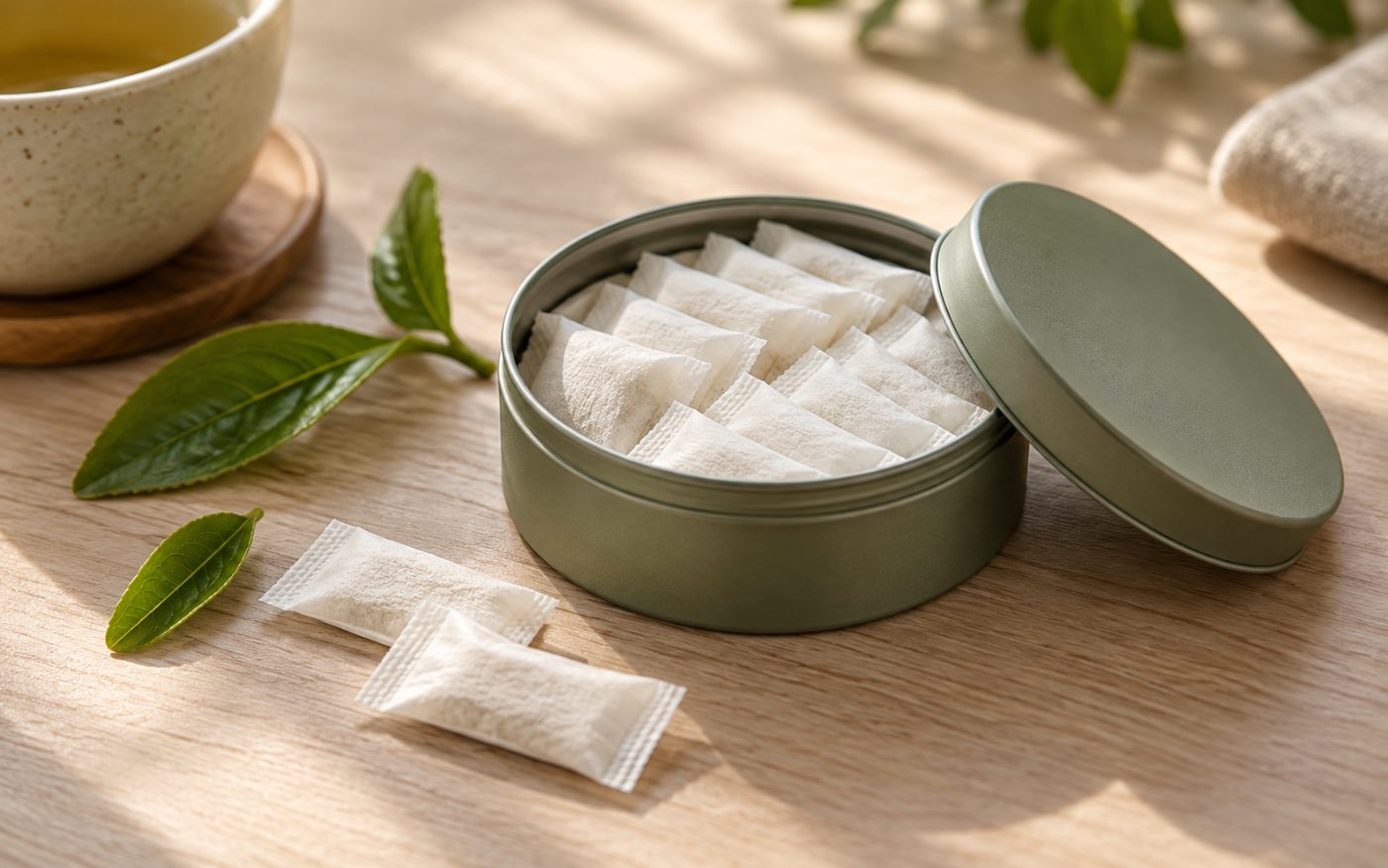
- Choosing a format that fits the moment. Some people take a capsule with breakfast. Others prefer a pouch they can use while drinking their coffee at their desk.
Because the coffee already supplies the caffeine, a caffeine-free L-theanine product avoids doubling up. Most capsules and many pouches are caffeine free, but it's worth checking the label.
A few sensible precautions
- Keep an eye on your total caffeine. Health bodies including the NHS and EFSA advise pregnant women to keep caffeine under 200mg a day.
- Check whether a product already contains caffeine before adding it to your coffee. Many "focus" blends do.
- Speak to your doctor or pharmacist first if you take medication, especially for blood pressure, or if you're pregnant or breastfeeding.
The bottom line
L-theanine and coffee are paired for a good reason: tea contains both naturally, and researchers have studied the combination more than almost any other. The studies reported small effects on attention and alertness in controlled settings, which is interesting but not conclusive. If you enjoy coffee and you're curious, adding L-theanine to your routine is easy, and you can choose the format that suits you. Our guide to L-theanine pouches explains one of the newer options.
Sources
- Owen GN et al. (2008). The combined effects of L-theanine and caffeine on cognitive performance and mood. Nutritional Neuroscience, 11(4), 193–198.
- Haskell CF et al. (2008). The effects of L-theanine, caffeine and their combination on cognition and mood. Biological Psychology, 77(2), 113–122.
- Giesbrecht T et al. (2010). The combination of L-theanine and caffeine improves cognitive performance and increases subjective alertness. Nutritional Neuroscience, 13(6), 283–290.
- Camfield DA et al. (2014). Acute effects of tea constituents L-theanine, caffeine, and epigallocatechin gallate on cognitive function and mood: a systematic review and meta-analysis. Nutrition Reviews, 72(8), 507–522.
- EFSA Panel on Dietetic Products, Nutrition and Allergies (2011). Scientific Opinion on the substantiation of health claims related to L-theanine. EFSA Journal, 9(6), 2238.
- Food Standards Agency. Caffeine content of common drinks.